Hail and straight-line wind don't hit Wake County evenly. A summer cell can drop pea-to-quarter hail on Falls River and Wakefield while Boylan Heights three miles away gets nothing but rain, which is exactly why a…
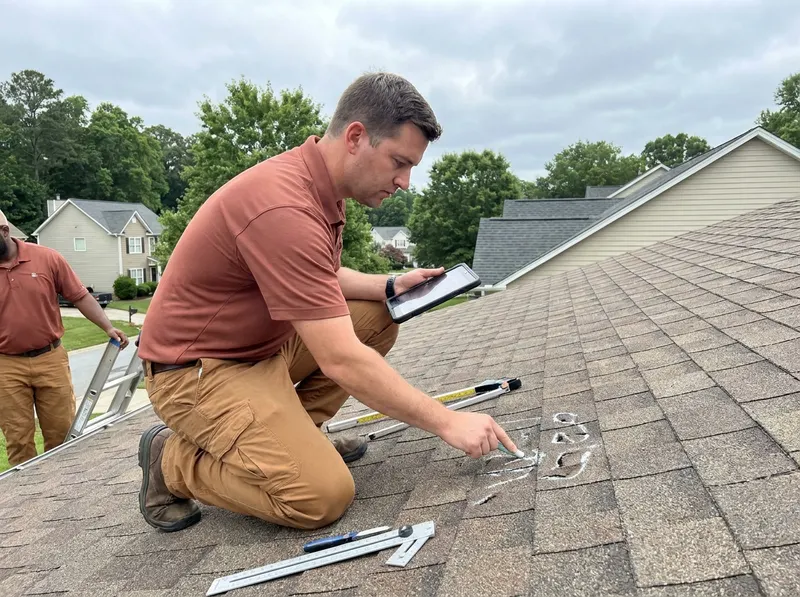
Hail and straight-line wind don't hit Wake County evenly. A summer cell can drop pea-to-quarter hail on Falls River and Wakefield while Boylan Heights three miles away gets nothing but rain, which is exactly why a general "the whole city got hit" claim helps nobody. What we're looking for is specific damage on your roof, on your address. On asphalt shingles that usually means granule loss with a bruised, soft mat underneath, wind creases where a shingle got folded back and set down again, torn nail heads, lifted ridge cap, and damaged pipe boots or step flashing. Hail almost always shows up first on soft metals, so gutters, downspouts, roof vents, and any aluminum trim get a close look before we make a call on the shingles themselves.
The housing stock changes the inspection. In Five Points, Hayes Barton, Historic Oakwood, and Mordecai you've got older homes with steep pitches, multiple valleys, dormers, and decades of mature oak and pine hanging over them — there, limb strikes and punctured decking are often the real story, and hail damage can be layered on top of ordinary wear. In Brier Creek, Wakefield, Falls River, and Stonehenge the roofs are newer with long ridge lines and architectural shingles, so wind uplift along the ridge and rakes is the common finding. North Hills sees a mix of both. We tell you which one you have, and we don't call normal aging "storm damage" to manufacture a job.
Here's the honest decision-fit. If the damage is isolated — a handful of wind-lifted shingles, one bad boot, a dented vent — a straight repair is usually faster and cheaper than opening a claim, and it keeps your policy history clean. If the hail bruising is spread across multiple slopes, or the deck is wet in more than one spot, documenting it for your insurer is the better path even though it takes longer and involves an adjuster visit and a deductible. The trade-off is speed and simplicity versus scope: repairs happen in days, claims take weeks but cover far more. We'll show you the photos and say plainly which side of that line we think you're on. If an adjuster is coming out, we can be on-site to walk the roof with them and point to the same findings we showed you.
A few things worth being straight about. We're a local roofing outfit, not a lead broker — the person who answers (984) 391-3020 is connected to the crew that shows up. We carry liability coverage and will provide our certificate before anyone sets a ladder against your house. And any number we give you at the assessment is a ballpark based on what we can see and measure that day; the exact figure comes in a written scope after the on-site visit, with no line items you have to decipher. That's the whole promise: show up, fix right, every time.
Every job gets a firm, written price after a free on-site visit.
Tell us about your storm and hail damage assessment job in Raleigh and we'll send a clear, written quote — usually the same day.
 Reliance Roofing Raleigh