Two very different Raleigh housing stocks create two very different ventilation problems. In Historic Oakwood, Boylan Heights, Mordecai, and parts of Five Points and Hayes Barton , the original houses were built with…
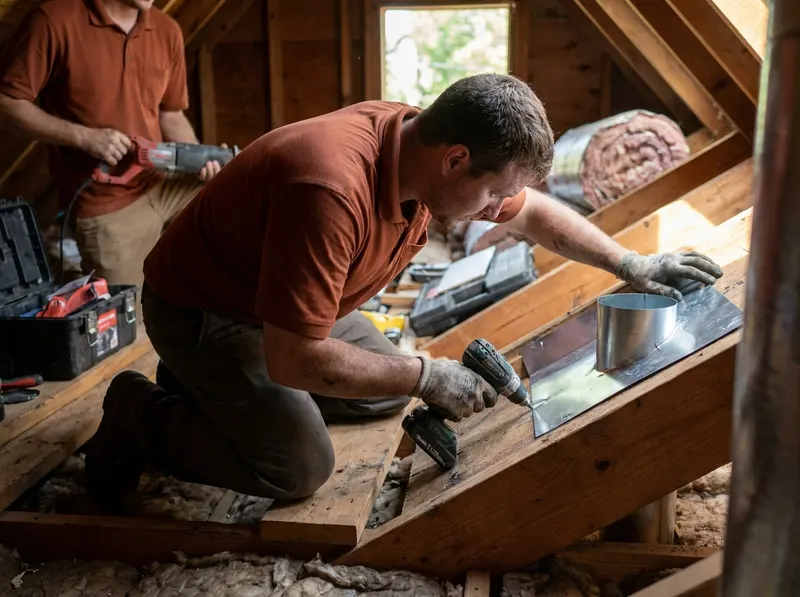
Two very different Raleigh housing stocks create two very different ventilation problems. In Historic Oakwood, Boylan Heights, Mordecai, and parts of Five Points and Hayes Barton, the original houses were built with shallow or nonexistent eave overhangs and a couple of gable vents doing all the work. Air goes in and out the same end of the attic, the middle stagnates, and by August the sheathing over the back bedroom is hot enough to shorten shingle life. In the 1990s-and-newer subdivisions — Brier Creek, Wakefield, Falls River, Stonehenge — the vents were designed correctly, then blown insulation buried the soffit intake, or a re-roof crew shingled over the old box vents and left the ridge cut too short. Same symptom, opposite cause. That's why the attic gets looked at before anything gets quoted.
What we're checking for is simple and you can watch us do it: rusty nail tips or frost rings on the underside of the sheathing (winter condensation), dark gray staining or soft plywood near the ridge, insulation packed tight against the roof deck at the eaves, and bath or dryer fans exhausting straight into the attic instead of out through a roof jack. Raleigh's summer humidity plus 90-degree stretches means an under-vented attic here holds moisture year-round, not just in January. Loblolly pine straw and April pollen also matter — on shaded lots off Ridge Road and around Stonehenge, external vent screens and turbine housings clog with pine debris and the attic quietly stops breathing.
When ventilation repair is the right call: your roof surface is still in decent shape, but the attic is hot, humid, or stained, and you want to protect the shingles you already paid for. It's also the honest answer when a home inspection during a sale flags "inadequate attic ventilation" — that's usually a few hundred dollars of vent work, not a new roof. When it isn't: if shingles are already brittle, granule-bare, or the deck is spongy, adding vents to a roof with two years left is money spent twice. In that case the ventilation gets corrected as part of the replacement, and we'll say so instead of selling you a repair. The trade-off with a standalone repair is that ridge vent work means opening the ridge shingles — done right it's watertight through a Raleigh thunderstorm, but it does put new material on an aging roof line, and mismatched shingle color at the ridge is possible on older roofs.
The other trade-off worth knowing: powered attic fans move a lot of air, but if intake is blocked they'll pull conditioned air out of your living space and raise your power bill. Balanced passive venting — low intake, high exhaust, matched to your attic's square footage using the standard net-free-area rule of thumb — is usually the better fix for Raleigh homes, and it has no motor to fail. If you already have a powered fan, we'll test it and tell you straight whether it's helping.
You'll get one price, written out, with the vent count and the labor spelled out — no line item you have to call and ask about later. The person who looks at your attic is the person doing the work.
Every job gets a firm, written price after a free on-site visit.
Tell us about your attic roof ventilation repair job in Raleigh and we'll send a clear, written quote — usually the same day.
 Reliance Roofing Raleigh