Tarping is the right call when the roof is open and the sky isn't done. Raleigh gets afternoon thunderstorms that stack up one behind another in July and August, plus the tail ends of coastal systems that push inland…
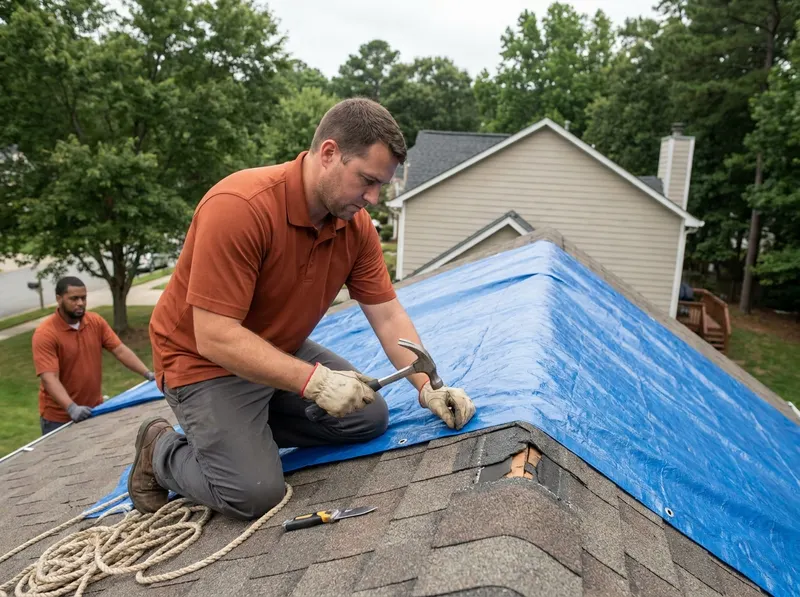
Tarping is the right call when the roof is open and the sky isn't done. Raleigh gets afternoon thunderstorms that stack up one behind another in July and August, plus the tail ends of coastal systems that push inland across Wake County with hours of wind-driven rain. In that pattern, a proper shingle repair can't be done well — asphalt and sealant need a dry deck to bond, and rushing it means doing it twice. A tarp buys the dry window. If the leak is active and more rain is coming, tarp first and repair after. If the roof is dry, the damage is small, and the forecast is clear, skip the tarp and go straight to the permanent repair — paying for both makes no sense when one visit will do.
The trade-off worth knowing: a tarp is temporary by design. It holds for weeks, not seasons, and every day it sits on the roof it's flexing in the wind and taking UV. Fasteners also have to go somewhere, so tarping on a roof you plan to keep is done with the follow-up repair in mind. Anyone who tells you a tarp is a long-term answer is stalling. Our position is simple: tarp today, then give you a plain written number for the actual fix so you can decide without pressure.
Raleigh's tree canopy is the reason a lot of these calls come in. Willow oaks and old pines over the 1920s houses in Historic Oakwood, Boylan Heights, and Five Points drop limbs that punch straight through decking, and those older roofs often have low-slope porch sections and tight valleys where water finds framing quickly. The steep multi-gable roofs around Hayes Barton and Mordecai are the opposite problem — the damage is usually small but the access takes longer and needs proper footing. Out in Brier Creek, Wakefield, Falls River, and Stonehenge, the newer subdivisions sit under tall loblolly pines with wide-open exposure, so we see more wind-lifted shingle fields and ridge-cap loss than impact holes. Each of those situations gets tarped differently, and the size of the cover depends on where the water is actually entering — not where the stain shows on your ceiling. Water travels along rafters and can surface a good ten feet from the hole.
On objections, straight answers. We are not a lead-gen middleman selling your phone number — you talk to the person who shows up. Ask for proof of insurance before anyone gets on your roof; that's a fair question and we expect it. We give you a time and we keep it, and if a storm cell delays the crew you get a call, not silence. Bring your camera phone out with us if you want — we photograph the damage and the finished tarp anyway, because most insurance carriers ask for exactly that when you open a claim, and having it before the tarp goes up matters. Show Up. Fix Right. Every Time. That includes the ugly 9 p.m. tarp jobs.
Every job gets a firm, written price after a free on-site visit.
Tell us about your emergency roof tarping job in Raleigh and we'll send a clear, written quote — usually the same day.
 Reliance Roofing Raleigh