Decking is the one roofing cost most homeowners never see coming, because it hides under the shingles until tear-off day. That is why we quote it as a per-sheet allowance up front instead of surprising you with a…
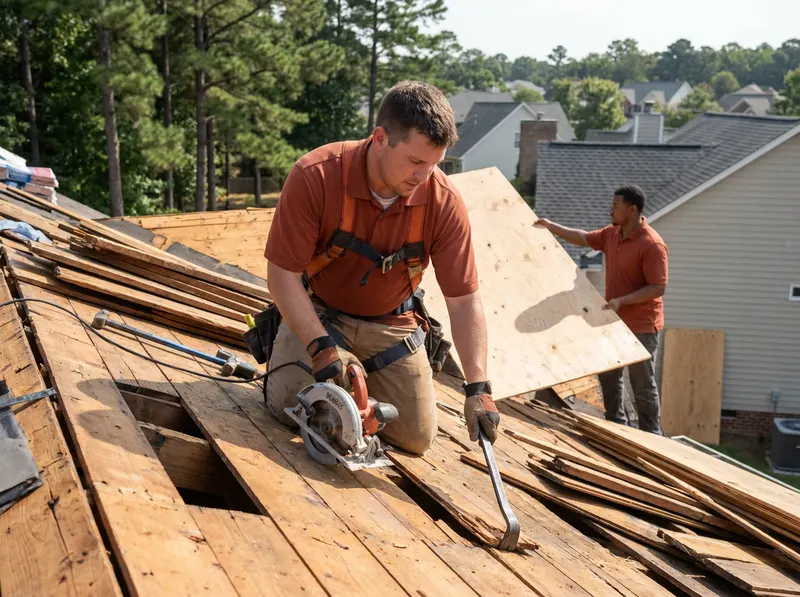
Decking is the one roofing cost most homeowners never see coming, because it hides under the shingles until tear-off day. That is why we quote it as a per-sheet allowance up front instead of surprising you with a change order at 2pm. You know the price of a sheet before we start, we count what we actually replaced, and you only pay for that. No vague "wood repairs as needed" line buried in the estimate.
Where it fits versus the alternative: if the wood is firm and only the shingles failed, you do not need new decking at all — a repair or a straight reroof over sound sheathing is the cheaper, correct call. Decking replacement earns its keep when a nail pops through a soft spot, when a screwdriver sinks into the sheathing near a valley or chimney, or when the roof plane visibly waves between rafters. The trade-off is real: replacing decking costs more and takes longer than laying shingles over questionable wood, but shingles fastened into punky sheathing lose their wind rating and start lifting on the next storm. Skipping it is the cheaper mistake that gets paid for twice.
Raleigh's housing stock creates two very different jobs. In Historic Oakwood, Boylan Heights, and Mordecai, many roofs sit on original 1x6 or 1x8 board planking with gaps between the boards — those often get overlaid with new plywood rather than board-for-board replacement, which keeps historic rooflines intact while giving modern shingles something solid to bite. Around Five Points and Hayes Barton, we most often find localized rot at chimney flashings, dormer sidewalls, and low-slope porch tie-ins where water tracked for years. Newer subdivisions in Brier Creek, Wakefield, Falls River, Stonehenge, and North Hills are typically OSB, which handles Wake County's humidity fine until it stays wet — then it swells at the edges and crumbles, usually near a poorly vented bath fan or under a damaged pipe boot.
Humidity and heat are the local variables. Wake County summers bake attics, and a roof deck that gets damp from a slow leak or condensation in an under-ventilated attic will not dry out the way it might in a drier climate. Remnants of tropical systems tracking inland past RDU drive water sideways under lifted shingles, so the damage often shows up several feet from the actual hole. When we open a section, we check the rafter tops and the attic side too — replacing sheathing without fixing the water path is just buying new wood to ruin. If ventilation is the root cause, we tell you that plainly rather than selling you more plywood.
You will get a real name and a phone number that a person answers, not a call center routing your address to whoever bids fastest. Ask us about coverage and paperwork before work begins and we will show you what we carry — you should ask that of any crew standing on your house. Call (984) 391-3020 and we will come look, on the day we said. Show Up. Fix Right. Every Time.
Every job gets a firm, written price after a free on-site visit.
Tell us about your roof decking replacement job in Raleigh and we'll send a clear, written quote — usually the same day.
 Reliance Roofing Raleigh