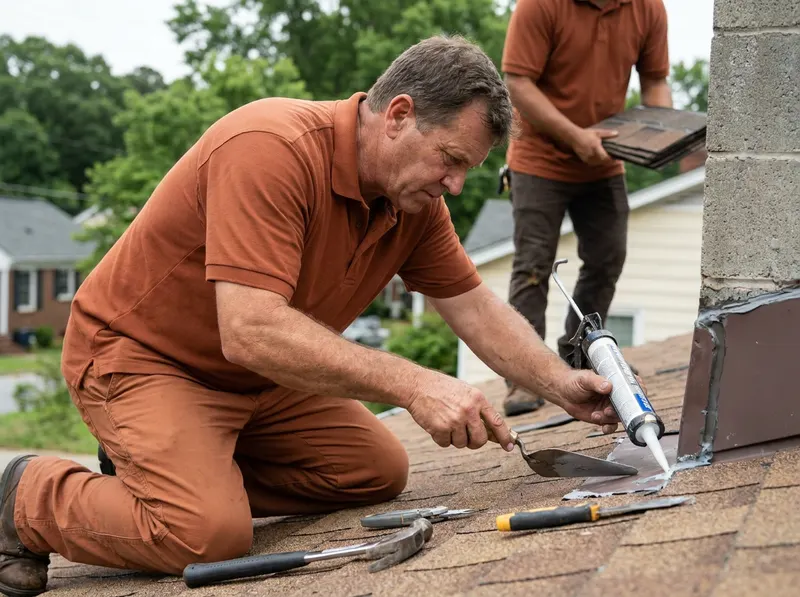
Leaks in Raleigh rarely announce themselves where they actually start. Water enters at a high point, runs down the underside of the decking or along a rafter, and drips out feet away from the source. That is why we work from both sides: attic first, tracing the stain uphill to the entry point, then on the roof to confirm what failed. Skipping the attic is how a leak gets "repaired" three times and still drips. We do not caulk over a problem and call it fixed.
The pattern changes by neighborhood, and that matters for what a repair costs. In Historic Oakwood, Boylan Heights, Mordecai, and Hayes Barton, we see older steep-slope roofs with multiple chimneys, dormers, and low-slope back porch additions — the leaks cluster at chimney flashing, valley metal, and the transition where a flat porch roof ties into a wall. Those details take time and a careful job. In Brier Creek, Wakefield, and Falls River, the roofs are newer and the failures are more predictable: builder-grade rubber pipe boots crack open around the 10-to-15 year mark, and a single split boot can soak a bathroom ceiling for months before anyone notices. Around Five Points, North Hills, and Stonehenge, the heavy oak and loblolly pine canopy is the real culprit — needles and leaves dam up a valley, water backs sideways under the shingles, and the leak shows up after the next hard afternoon thunderstorm.
Repair versus replacement is an honest conversation, not a sales pitch. Targeted leak repair is the right call when the shingles still have granules and flexibility, the leak traces to one identifiable detail, and the decking underneath is sound. Replacement makes more sense when we find widespread brittle or curling shingles, several unrelated leaks at once, or soft decking across a large area — at that point, repairs stack up and you are paying twice. The trade-off is straightforward: a repair costs a fraction of a new roof and buys real years, but it does not extend the life of a roof that is already at the end of it. If your roof only needs a repair, we will tell you that. We will also tell you plainly if we think a repair is throwing money at a roof that needs replacing, and show you the photos behind that opinion.
Storm season deserves its own note. Remnants of tropical systems tracking inland past Raleigh and RDU can push driven rain sideways under shingles and into wall intersections that never leak in ordinary weather. If you have water coming in during an active storm, call and we will get a temporary cover on it, then come back for a permanent repair in dry conditions — the fix holds better and we can see what we are doing. Same person quotes it, same person stands behind it. Ask us anything about coverage, scope, or how we arrived at the number, and you will get a direct answer rather than a badge on a website.